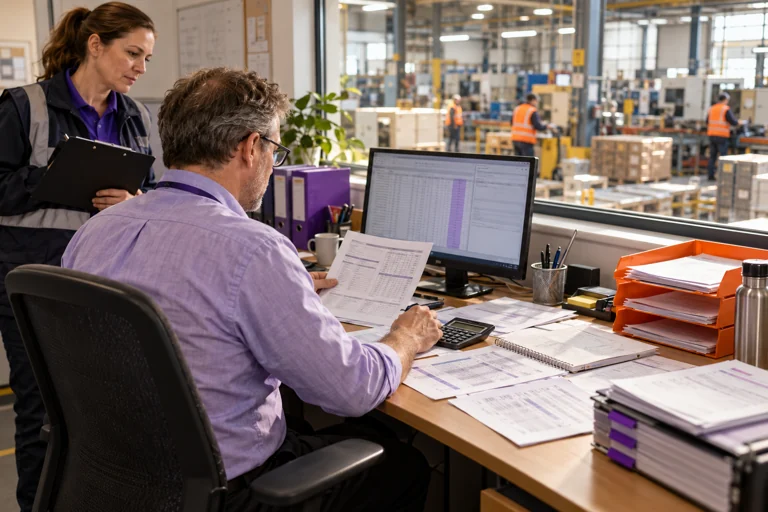
Your ERP system might still be running. But how much effort does it take to keep your business running around it?
Most businesses don't wake up one morning and decide their ERP system has become outdated.
It happens gradually.
A spreadsheet is introduced because the production planning team needs information the system cannot easily provide. Finance develops a workaround to produce a management report. Purchasing maintains a separate stock file because the figures in the system aren't always trusted.
Individually, these seem like sensible solutions to everyday problems.
Over time, however, they can become an accepted part of how the business operates.
People spend more time checking information, departments develop their own ways of working, and experienced employees become essential to keeping processes moving.
The ERP system is still there. It's still processing transactions. And because the business continues to operate, there may be little immediate pressure to question it.
But there's an important distinction between having an ERP system that works and having an ERP system that works well for your business.
For manufacturers and distributors, that distinction can have significant operational and commercial consequences.
The question isn't necessarily whether you need new ERP software.
It's whether your current environment is helping your people make better decisions, work efficiently and support the business you want to become.
01 What makes an ERP system 'legacy'?
The term legacy ERP is often used to describe older software. But age alone isn't a reliable measure of whether a system remains fit for purpose.
An established ERP platform can continue delivering real value when it is well supported, properly maintained and aligned with the organisation's needs.
Equally, a relatively new ERP implementation can create difficulties if it has been poorly configured, inadequately integrated or designed around processes that no longer reflect how the business operates.
A system becomes problematic when its limitations begin affecting the organisation's ability to operate, adapt or grow.
These limitations might include:
- Difficulty accessing reliable, up-to-date information across departments.
- Heavy dependence on spreadsheets, duplicate data entry or manual reconciliation.
- Limited integration between ERP and other business-critical applications.
- Customisations that are increasingly difficult or expensive to maintain.
- Inadequate functionality for changing manufacturing, inventory or distribution requirements.
- Dependence on unsupported technology or specialist knowledge held by a small number of people.
- Inability to adapt processes without significant development or disruption.
None of these issues automatically means a system needs replacing.
However, they are signs that the business should examine whether its current technology is still providing an appropriate foundation.
03 What could these inefficiencies actually be costing your business?
Let's consider a hypothetical manufacturing business.
It employs 12 people who regularly spend time on spreadsheet maintenance, duplicate data entry, manual reconciliations and workarounds associated with its current systems.
Suppose each person spends an average of three hours per week on these activities.
With an illustrative fully loaded employment cost of £30 per hour and 46 working weeks per year, the calculation would be:
| Calculation | Annual amount |
|---|---|
| 12 employees × 3 hours per week | 36 hours per week |
| 36 hours × 46 working weeks | 1,656 hours |
| 1,656 hours × £30 | £49,680 |
| Additional, separately verified annual costs (illustrative) | £15,000 |
| Total indicative annual cost | £64,680 |
That's over £64,000 of annual staff capacity value and assumed incremental expenditure associated with the identified activities.
Over five years, the same unchanged annual assumptions would represent £323,400 before adjusting for inflation, discounting, process changes or other factors.
But there is an important distinction: this is not automatically £64,680 that the business could save by implementing new ERP.
The time may be redistributed into more valuable work rather than reducing payroll expenditure. Some manual activities may remain necessary. Others may arise from process design or data quality rather than the ERP platform itself.
Any investment case needs to establish which activities can realistically be improved, what proportion of the benefits can be achieved, and how much the proposed changes would cost.
Nevertheless, the exercise demonstrates why understanding existing inefficiencies matters.
Before committing to a major technology project, a business should understand what it is trying to improve and why that improvement has commercial value.
04 Ten signs it may be time to reassess your ERP
You don't necessarily need a formal systems review to recognise the early warning signs.
Consider how many of the following statements apply to your organisation:
- Important business processes rely on spreadsheets outside the ERP.
- Employees regularly enter the same information into multiple systems.
- Management reports require extensive manual preparation.
- Different departments sometimes work from conflicting information.
- Production or purchasing decisions are affected by unreliable stock information.
- Integrating new applications is costly, slow or technically difficult.
- Employees depend heavily on a small number of colleagues who understand historic workarounds.
- Changing established processes requires disproportionate effort.
- The system's technology, support or security arrangements create concerns.
- The business has grown or changed significantly, but the ERP environment has not evolved with it.
These are not reasons to replace ERP automatically.
They are reasons to investigate whether your processes, technology and operating requirements are still properly aligned.
For example, frequent spreadsheet use might indicate a missing ERP capability. But it could also reveal insufficient training, inadequate reporting configuration or a business process that needs redesigning.
Understanding the cause is more important than simply counting the symptoms.
05 Does your business need to replace its ERP — or make better use of what it already has?
This is arguably the most important question in the entire modernisation discussion.
When organisations encounter ERP difficulties, there can be a temptation to assume the system itself is the problem.
Sometimes it is.
But an ERP environment is a combination of software, data, integrations, processes, people and governance.
Replacing one component doesn't automatically fix the others.
Before deciding on a replacement project, businesses should consider five potential approaches.
Option 1: Optimise the existing system
If the core ERP platform remains suitable, the greatest opportunity may be improving how it is configured and used.
This could involve simplifying processes, improving master data, introducing better reporting or ensuring employees understand existing functionality.
It may also involve reviewing bespoke customisations that are no longer necessary.
Optimisation is particularly relevant when the technology itself is capable of supporting the business, but the organisation is not achieving its full value.
Option 2: Improve integration
A business may have an effective core ERP system but struggle because important applications are disconnected.
Integrating systems such as CRM, ecommerce, warehouse management or production applications could improve information flow without requiring wholesale ERP replacement.
However, integration should be designed carefully.
Connecting poorly defined processes or inconsistent data can simply move errors between systems faster.
Option 3: Upgrade the existing platform
An upgrade may provide access to improved functionality, supported technology, better integration options and security enhancements.
This can be appropriate when the ERP vendor's product roadmap remains aligned with the organisation's future requirements.
The upgrade still requires careful planning, particularly where historic customisations or integrations are involved.
Option 4: Modernise in stages
Some businesses benefit from a phased programme of change.
Rather than replacing everything at once, they address specific processes, integrations or capabilities according to commercial priority.
A phased approach may help manage risk and resource demands, although it can also introduce temporary complexity while older and newer systems coexist.
The right sequencing depends on operational dependencies and the organisation's ability to manage change.
Option 5: Replace the ERP system
Full replacement may be appropriate when the existing platform can no longer support essential requirements, has unacceptable support or security limitations, or would require disproportionate investment to remain viable.
A replacement programme provides an opportunity to rethink processes and establish a stronger technology foundation.
But it should be approached as a business transformation initiative, not simply a software installation.
The objective should be to improve how the organisation operates, not reproduce every existing workaround in a new system.
The best decision is the one that addresses the underlying business problem with an appropriate balance of value, cost and risk.
06 How to build a business case for ERP modernisation
Whether you're considering optimisation, an upgrade or complete replacement, a credible business case begins with understanding your current position.
Establish a baseline
Start by identifying measurable problems.
Examples might include the time required to produce management reports, inventory accuracy, manual order-processing effort, production schedule adherence or the number of errors requiring rework.
Where possible, gather real operational data rather than relying entirely on estimates.
Understand the full cost
An ERP business case should compare more than licence fees.
Depending on the available options, relevant costs could include:
- Software subscriptions, licences and infrastructure.
- Implementation and consultancy.
- Data cleansing and migration.
- Integration development and testing.
- Staff training and internal project resources.
- Process redesign and change management.
- Ongoing support, maintenance and future enhancements.
- Temporary disruption, parallel running or additional controls during transition.
This provides a more realistic foundation for comparing different approaches.
Quantify achievable benefits
Identify what will improve and how success will be measured.
Some benefits can be financial, such as reduced external expenditure or lower avoidable operating costs.
Others may involve increased capacity, improved control, faster reporting or better customer service.
Where the benefit is difficult to quantify reliably, describe it transparently rather than attaching an unsupported financial figure.
Consider implementation risk
ERP modernisation can involve significant operational change.
Data quality problems, insufficient testing, unclear responsibilities, inadequate training or unrealistic implementation assumptions can undermine an otherwise sensible investment.
A strong business case should account for these risks and explain how the organisation intends to manage them.
Build a realistic evaluation
Compare plausible options over an appropriate period, often using a multi-year total cost of ownership model.
Include the cost of doing nothing, but don't assume this remains constant or that every inefficiency disappears under a replacement system.
Sensitivity testing is valuable. What happens if implementation costs increase, benefits take longer to realise, or employee adoption is slower than planned?
The strongest business case isn't necessarily the one with the highest projected return.
It's the one based on assumptions that management understands, can challenge and has confidence in delivering.
07 What could a more connected ERP environment change?
For manufacturers and distributors, the potential value of a well-designed ERP environment comes from bringing people, processes and information together.
Consider a customer order.
In a disconnected environment, sales may need to ask another department to confirm availability. Production planning may maintain its own schedule. Purchasing might use separate spreadsheets to track materials, while finance reconciles the resulting transactions later.
In an appropriately configured and integrated ERP environment, these activities can be supported by a more consistent flow of information.
Customer orders, inventory, purchasing, production and financial records can be connected to reduce duplication and improve visibility.
That can help different teams understand the consequences of their decisions and respond more effectively.
Solutions such as Oracle NetSuite offer integrated business management capabilities spanning finance, inventory, order management and other operational processes, with additional functionality and integrations available for different requirements.
But the value doesn't come from the software name alone.
It comes from understanding the business, designing appropriate processes, configuring the system correctly and helping employees use it effectively.
Technology provides the capability. Good implementation, reliable data and engaged people turn that capability into business value.
08 Where should you start? A practical 30-day ERP health check
You don't need to begin with a software demonstration or a large transformation programme.
A focused assessment of your existing environment can provide valuable clarity before any major decision is made.
Week 1: Listen to the people using the system
Speak with employees across operations, purchasing, finance, sales and customer service.
Ask which tasks take longer than they should, where they rely on spreadsheets, what information they struggle to obtain and which processes cause repeated frustration.
Look for recurring problems rather than isolated complaints.
Week 2: Follow the information
Choose one or two important business processes, such as order-to-cash or procure-to-pay.
Follow the information through each step.
Identify where it is entered, copied, checked, corrected or transferred between applications.
This can help reveal the points where disconnected systems or inefficient processes create additional work.
Week 3: Measure the impact
Establish a baseline for the most significant problems.
How many hours are spent each week on manual reporting?
How often do stock discrepancies require investigation?
What additional expenditure is associated with maintaining workarounds?
Which operational issues are genuinely linked to systems or data limitations?
Prioritise areas where there is sufficient evidence of business impact.
Week 4: Evaluate your options
Review whether the problems can be addressed through process improvements, training, configuration, better data management, integration, upgrades or broader modernisation.
Consider cost, risk, internal resources and long-term requirements.
The objective at this stage isn't necessarily to choose new software.
It's to develop a clear, evidence-based understanding of what should change.
At the end of 30 days, your organisation should be in a stronger position to decide whether further investment is justified and where it could deliver the most value.
09 Don't let the cost of change distract you from the cost of standing still
Changing ERP can be a significant decision, particularly for businesses with complex manufacturing and distribution operations.
Implementation costs, disruption risk and the challenge of changing established ways of working are legitimate concerns.
They deserve careful consideration.
But remaining with the current environment is also a decision, with its own costs and consequences.
If manual workarounds are increasing, management information is difficult to trust or existing technology is becoming harder to support, doing nothing may not be the lowest-risk option.
Equally, if your ERP platform is stable, supported and capable of meeting future needs, improving it may be more sensible than replacing it.
The important thing is to make that decision deliberately rather than allowing circumstances to decide for you.
A useful starting point is to ask three questions:
What is our current ERP environment helping us achieve?
Where is it creating unnecessary effort, cost or risk?
What changes would make the greatest difference to our business?
The answers can help turn a vague concern about ageing technology into a practical plan for improvement.
10 Let's talk about what could work better
At Web Control, we understand that ERP decisions are about more than technology.
They're about how your people work, how information moves through your business and how effectively your systems support your operational and commercial goals.
Sometimes the right next step is making better use of the technology you already have.
Sometimes it's improving integration or reviewing existing processes.
And sometimes a broader ERP modernisation programme is the right direction.
Our role is to help businesses explore those challenges, understand their options and make informed decisions about what comes next.
If you're questioning whether your current ERP system is still right for your business, let's have a conversation.
Talk to Web Control about your ERP challenges and modernisation options.
11 Frequently asked questions
What is a legacy ERP system?
A legacy ERP system is generally an established enterprise resource planning environment whose technology, support arrangements or functional limitations are becoming increasingly difficult to align with an organisation's requirements. An older platform is not automatically legacy simply because of its age.
How do I know if my ERP system needs replacing?
Warning signs include excessive manual workarounds, difficult integrations, unsupported technology, unreliable management information and an inability to meet essential business requirements. However, these problems should be assessed before deciding on replacement, as configuration, processes or data quality may be contributing factors.
Is cloud ERP always better than on-premise ERP?
Not necessarily. Cloud ERP can offer benefits in areas such as managed infrastructure, accessibility and access to vendor-delivered updates, depending on the product and service arrangements. The appropriate deployment model depends on the organisation's requirements, security obligations, integration needs, costs and available resources.
How much does it cost to replace a legacy ERP system?
There is no meaningful universal price. Costs vary according to business size, users, operational complexity, modules, customisations, data quality, integration requirements and implementation approach. Businesses should evaluate total costs rather than compare software subscriptions alone.
Can an existing ERP be improved without replacing it?
Yes. Many organisations can improve results through better configuration, process redesign, employee training, data improvements, new reporting capabilities or integration with other applications. The feasibility depends on the capabilities and ongoing support of the current platform.
What is the difference between ERP modernisation and ERP replacement?
ERP modernisation is the broader process of improving an organisation's ERP environment. It may involve optimisation, upgrading, integration, architectural changes or phased transformation. Replacement is one possible approach within that broader process.
How long does ERP modernisation take?
The timeframe depends on the changes being made. A targeted reporting or process improvement may be much smaller than a multi-site ERP replacement. Project scope, data readiness, customisation, integration requirements and organisational change all affect delivery timescales.
How can we measure the ROI of ERP modernisation?
Begin with a measurable baseline and identify realistic improvements in operating costs, staff capacity, inventory, reporting, controls or other relevant outcomes. Compare achievable financial benefits with the full investment and ongoing costs, accounting for timing, delivery risks and uncertainty.
Will implementing new ERP solve our existing process problems?
Not automatically. Poor data, unclear responsibilities, ineffective processes and inadequate user adoption can persist after new software is introduced. Successful ERP improvement requires attention to people, processes, information and technology together.